Your company has information. Your teams need answers.
Organizations accumulate years of policies, procedures, contracts, financial reports, research and operational guidance. The difficulty is rarely that information does not exist. It is that people cannot reliably find the current, relevant and authorized passage when work requires it.
A general-purpose model can explain a concept, but it does not automatically know a company's latest approved policy or the conditions in a particular agreement.
For executives, this is the business case for enterprise retrieval-augmented generation, or RAG, and document intelligence. They help connect AI to organizational knowledge so employees can work from relevant context instead of generic answers. The business outcome is not simply a conversational interface. It is faster access to usable information with explicit ownership, access rules and review.
What enterprise RAG does - and what it does not
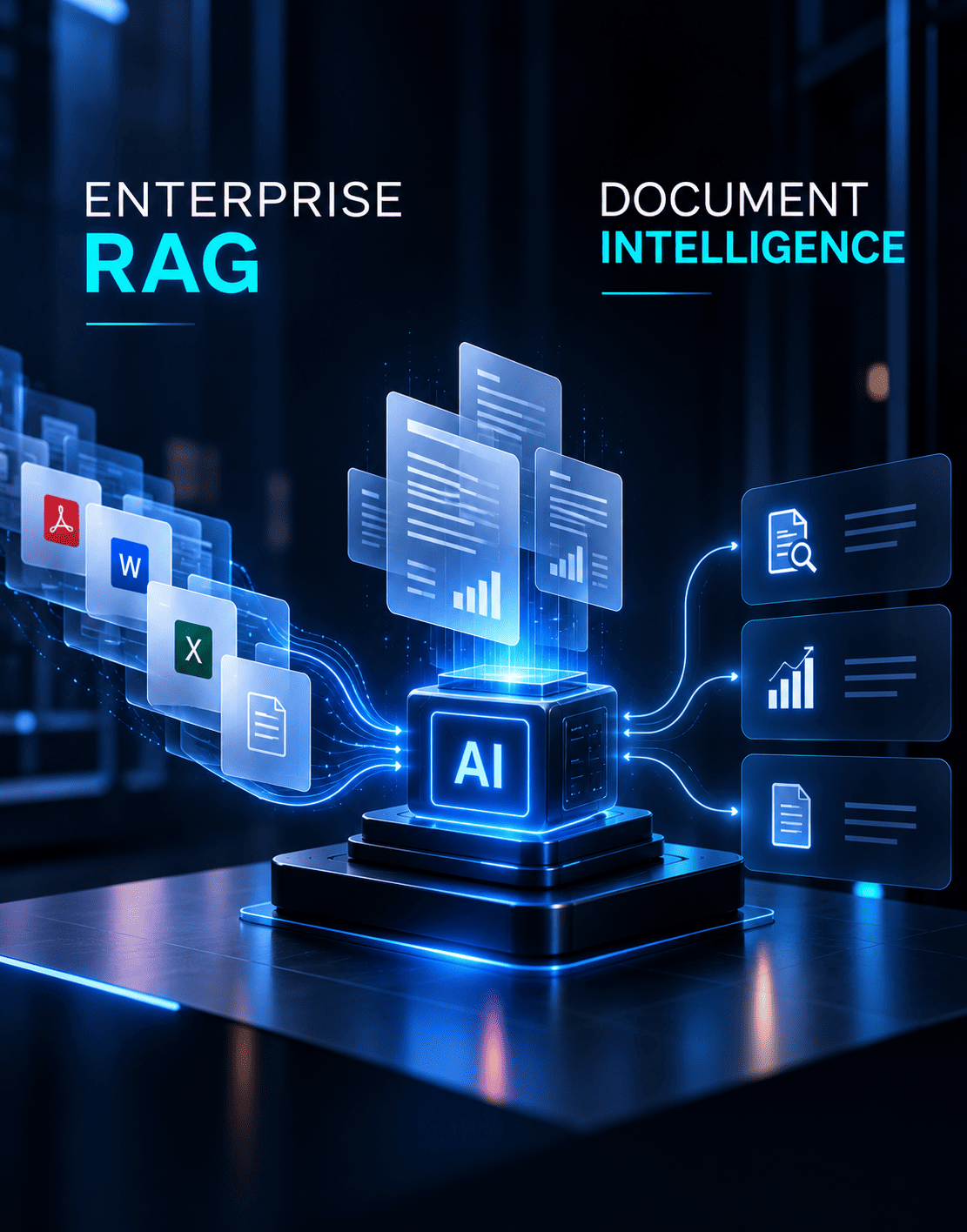
In a typical RAG workflow, a user asks a question; the system searches approved sources; relevant information is retrieved; and the model uses that context to generate a response. The retrieval step can improve relevance and make supporting passages available for review.
It does not automatically guarantee factual accuracy. Poor source quality, stale indexes, ambiguous wording or incorrect permissions can still produce bad outcomes.
SANCTUM describes this path as connecting approved information, understanding it, retrieving the right context, applying private AI and supporting a governed next step. Its published capabilities include local chat, hybrid RAG, OCR, classification, extraction, summarization and document analysis. Buyers should validate exact supported formats, connector behavior and evaluation results for their own documents.
Why document intelligence comes before a good answer
Enterprise content is not one clean database. It may include scanned PDFs, tables, attachments, images, inconsistent metadata and multiple versions of a policy. Before an AI assistant can answer reliably, the information must be prepared.
OCR turns scanned text into machine-readable content. Classification identifies document types. Extraction captures entities, fields and tables. Version and source metadata help determine which content is authoritative.
Consider a financial services employee asking about an internal procedure. The answer should be based on the approved, current version, not a superseded file from an archive. A legal team comparing clauses needs document boundaries and accurate attribution. A quality team reviewing a procedure needs an auditable route back to the underlying source. These are knowledge-engineering problems as much as model problems.
Four decisions that determine business value
Choose the workflow, not the technology label.
Begin with a task such as policy Q&A, contract comparison, report summarization or support-agent assistance. Define who uses it, what decision it supports and what an acceptable output looks like. Avoid launching a universal assistant without a defined owner.
Curate the sources.
Establish an approved source inventory, version policy, update cadence and retention rules. Assign business owners to high-value repositories. Measure whether the system retrieves the correct passages when documents conflict or are replaced.
Enforce permission-aware retrieval.
An employee should not gain access to restricted information because an AI assistant has a broad index. Map identity, roles, knowledge-base permissions and document ACLs into retrieval. Re-authorize retrieved passages for the requester. Test users with different entitlements, including revoked access.
Keep people in consequential decisions.
A generated summary can support review, but it should not silently approve a loan, issue legal advice or make a clinical decision. Define where the assistant can answer, where it should cite a source, and where a person must review or approve the next step.
The metrics a C-suite dashboard should show
A pilot should track more than the number of chats. Useful measures include time to locate an approved answer, percentage of answers with valid supporting sources, retrieval relevance, refusal quality, document processing errors, user satisfaction, latency and cost per completed workflow.
Security metrics should include unauthorized retrieval attempts, permission failures and incident-response readiness. Business teams should compare the assisted process against a baseline rather than extrapolating from a polished demo.
Create a small but representative test set: common questions, difficult multi-document questions, conflicting versions, missing information and adversarial instructions embedded in documents. Evaluate each model or retrieval change against the same set. This makes quality visible and helps prevent a new release from degrading a working workflow.
From knowledge assistant to governed action
The first phase may answer questions. The next may extract data, prepare a draft, compare policies or route a case for review. SANCTUM presents five connected capability areas: Knowledge Assistant, Document Intelligence, Compliance Copilot, Agent Assist and AI Agents.
Its operating flow moves from connect and understand to retrieve, reason, assist and act. This progression is valuable only when permissions, review requirements and workflow boundaries remain intact.
For example, a support employee could retrieve an approved procedure, receive a draft response and decide whether to use it. A compliance analyst could compare relevant policies and inspect the source passages. These are practical assistance patterns, not a promise of autonomous decision-making or error-free output.
Deployment choices still matter
A document assistant processes prompts, passages and generated outputs that may contain sensitive information. Leaders should map where each artifact is stored, where inference runs and which services are reachable.
SANCTUM is designed around a controlled environment and offers on-premises, private-cloud, air-gapped and hybrid deployment approaches. Local processing can reduce exposure, but external identity, update, certificate and approved integration flows must still be assessed for cross-border and contractual implications.
A 90-day approach to a credible first use case
In the first phase, select the workflow, stakeholders, sources and risk classification. In the second, prepare documents and build a baseline retrieval evaluation. In the third, test permissions, output quality and human review with a small user group. In the fourth, measure business results and operational readiness, then decide whether to expand.
The timeline is a planning framework, not a guaranteed deployment commitment. A successful enterprise RAG program creates a repeatable way to turn private knowledge into usable assistance. The model matters, but the differentiated value comes from the quality of your information, the retrieval design and the controls around its use.
Can RAG eliminate hallucinations?
No. It can provide relevant context and support verification, but outputs still need evaluation and appropriate review.
Can we connect every repository at once?
It is usually more manageable to start with approved, owned sources and expand after testing quality and permissions.
What should procurement ask?
Request a connector inventory, data-flow diagram, role and ACL tests, model evaluation approach, support terms, and a documented operating model.